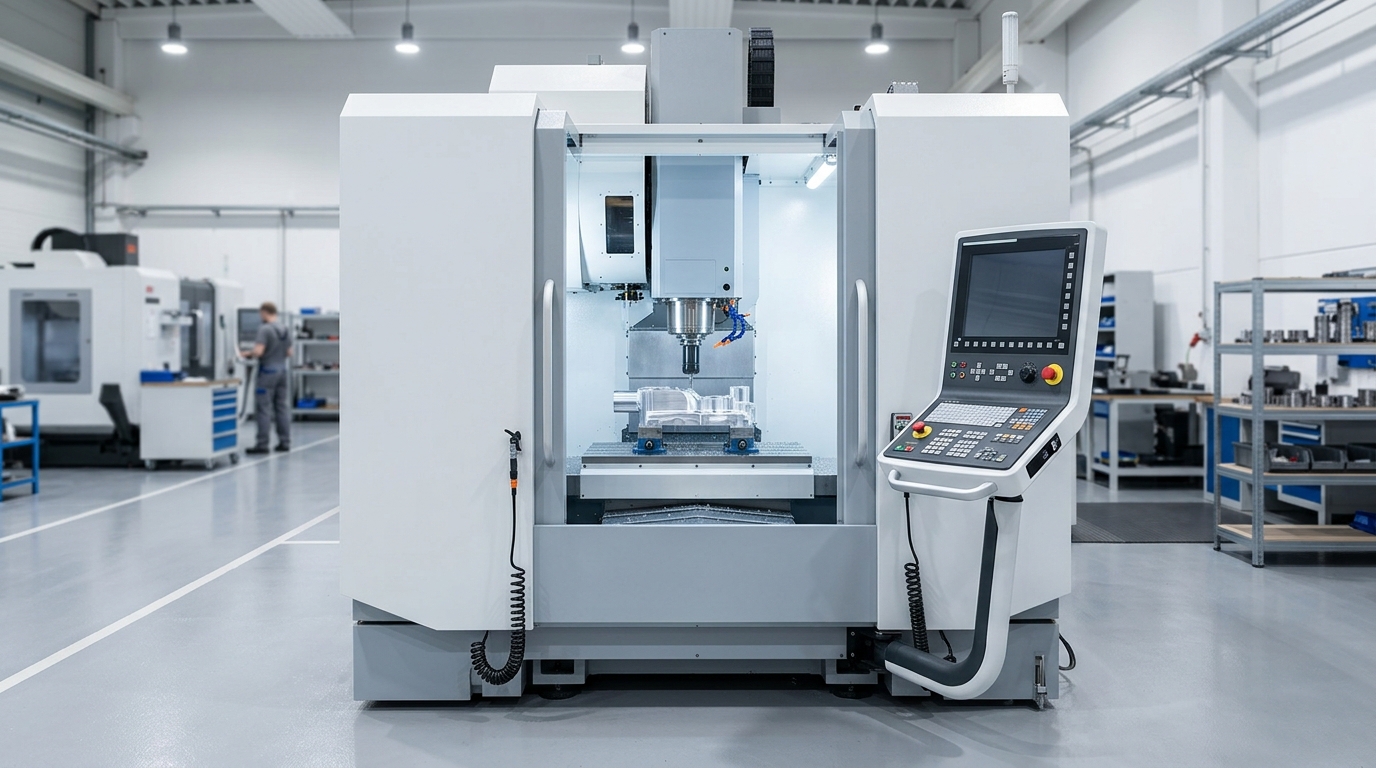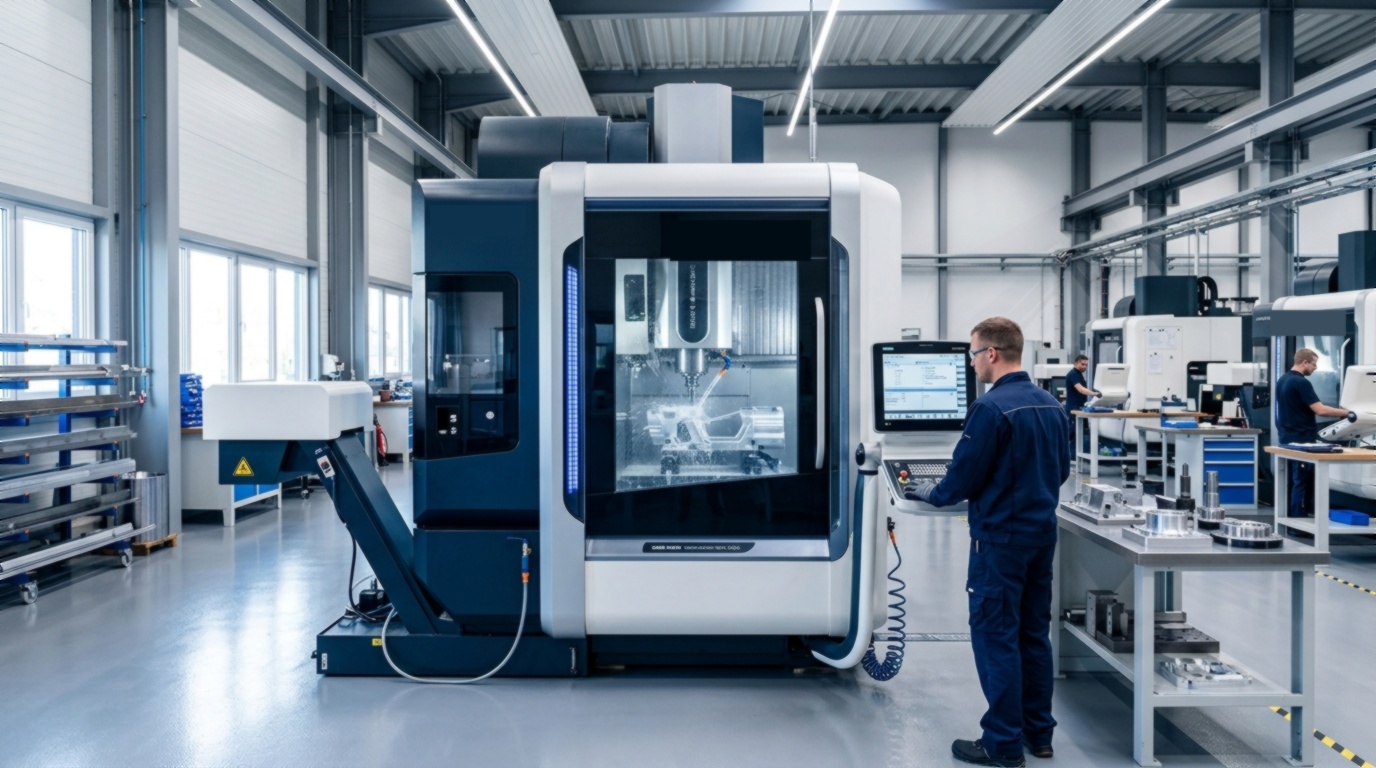
- Subtractive Transformation: A CNC machine carves, cuts, turns, and shapes solid raw billets into finished parts by systematically removing excess material.
- Multi-Process Versatility: Modern machines perform face milling, pocket milling, drilling, rigid tapping, cylindrical turning, thread cutting, and 3D surface profiling.
- Broad Material Range: Capable of machining aluminum alloys, stainless steel, hardened tool steels, titanium, brass, bronze, cast iron, and high-performance plastics (PEEK, Delrin).
- Global Industry Footprint: Critical for producing aerospace jet engine components, automotive transmission housings, surgical implants, injection mold cavities, and consumer tech frames.
The Core Function: Precision Subtractive Manufacturing
At its simplest level, what does a CNC machine do?
A CNC machine is an automated material-removal system. While 3D printing is additive (building up a component layer by layer), CNC machining is subtractive. It begins with a solid stock block of metal, plastic, or composite (known as a billet, bar, or casting), and utilizes spinning or stationary cutting tools to slice away unwanted material until the precise three-dimensional geometry remains.
Because CNC machines apply rigid cast-iron damping and carbide cutting edges under high-pressure coolant, they can produce complex components with surface finishes as fine as Ra 0.4 μm and dimensional tolerances within ±0.005 mm.
The 6 Essential Operations a CNC Machine Performs
Modern Computer Numerical Control equipment performs a diverse range of metalworking processes:
1. Face Milling & Surface Squaring
Using large multi-insert face milling cutters, the machine sweeps across the top of a raw stock block to produce a perfectly flat, planar datum reference surface.
2. Pocketing, Cavity Milling & Slotting
End mills plunge and traverse along complex 2D contours, removing interior pockets, weight-reduction cavities, O-ring seal grooves, and precise keyways.
3. Drilling, Reaming & Rigid Tapping
- Drilling: Carbide drills pierce holes at exact X-Y coordinate centers.
- Reaming: Precision multi-flute reamers shave a final 0.1 mm to achieve H7 tolerance hole diameters for dowel pins.
- Rigid Tapping: The spindle rotation synchronizes precisely with the Z-axis feed rate to thread M3 to M36 internal screw threads without breaking taps.
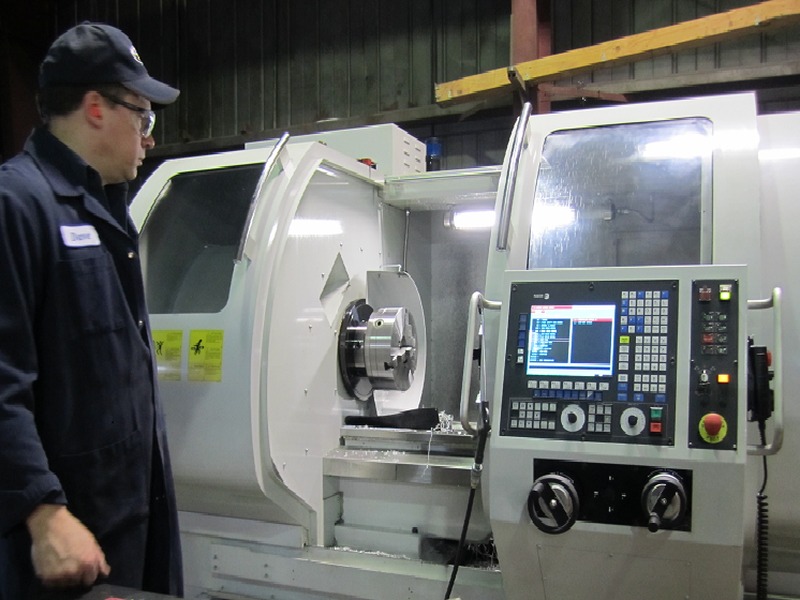
4. Cylindrical Turning, Facing & Boring (CNC Lathes)
The workpiece spins at 1,000 to 4,500 RPM while a single-point carbide insert moves axially and radially, producing cylindrical shafts, stepped diameters, tapers, spherical balls, internal bores, and external threads.
5. 3D Complex Contour Sculpting
Using ball-nose end mills, multi-axis machining centers calculate fine stepover passes to sculpt organically curved aerodynamic airfoils, turbine blades, automotive hood dies, and medical prosthetics.
6. 5-Axis Multi-Sided Machining
Rather than stopping to reclamp a workpiece five times across different vise setups, a 5-axis machining center articulates the tool around the part, completing 5 faces in a single continuous cycle.
What Materials Can a CNC Machine Cut?
| Material Family | Common Alloys | Primary Industrial Uses |
|---|---|---|
| Aluminum Alloys | 6061-T6, 7075-T6, 5083, 2024 | Aerospace frames, robotics chassis, electronic enclosures, heatsinks. |
| Carbon & Alloy Steels | 1018, 1045, 4140, 4340, 8620 | Shafts, gears, hydraulic cylinders, heavy mechanical linkages. |
| Stainless Steels | 304, 316L, 17-4 PH, 420 | Food processing machinery, chemical valves, marine fittings, surgical tools. |
| Superalloys & Titanium | Titanium Gr. 5 (Ti-6Al-4V), Inconel 718 | Jet engine combustors, rocket nozzles, orthopedic bone implants. |
| Engineering Plastics | Delrin (POM), PEEK, PTFE, Nylon, UHMW | Electrical insulators, semiconductor carriers, wear bushings. |
Real-World Industrial Parts Made by CNC Machines
Across virtually every manufacturing sector, CNC machines are responsible for producing the most mission-critical parts:
- Aerospace & Defense: Jet engine blisks, landing gear struts, satellite structural brackets, fuel manifold bodies.
- Automotive: Engine cylinder heads, crankshafts, transmission gears, performance brake calipers, suspension knuckles.
- Medical & Dental: Titanium hip replacement joints, spinal fixation cages, dental abutments, surgical bone drills.
- Molds & Tooling: High-cavity plastic injection molds, die-casting dies, metal stamping punches.
- Energy & Oil/Gas: Drill bit heads, subsea valve manifolds, centrifugal pump impellers, wind turbine gearbox housings.
Frequently Asked Questions
Can a CNC machine cut steel?
Yes. Heavy-duty CNC machining centers and CNC lathes built with Meehanite cast-iron beds, BT40/BT50 geared or direct-drive spindles, and high-pressure flood coolant routinely machine hardened carbon steels, alloy steels, and stainless steels.
What is the difference between CNC milling and CNC turning?
In CNC milling, the workpiece remains stationary on the table while the cutting tool spins to cut complex contours. In CNC turning, the workpiece spins in a chuck while stationary tools shave its diameter to form cylindrical shafts and round parts.
What does a CNC router do compared to a CNC mill?
A CNC router operates with higher spindle speeds (up to 24,000 RPM) across large working tables, specializing in wood, acrylic, sheet plastics, and light aluminum panels. A CNC mill features significantly higher structural mass and cutting torque to machine solid steel, cast iron, and titanium blocks with tighter tolerances.